<!--Can't find substitution for tag [blog.pagetitle]--> daily for info : Latest technology, gadgets, Sporty Magazine, tips, free sms, adsens, Web apps, technology trends and social media.Bad Habits Anime Collectables Computer Software, pc tips, tech tips

.

.
Showing posts with label American history. Show all posts

Wednesday, January 1, 2014

Causes of US Involvement in World War II


Following World War I, the United States adopted an isolationist stance. Starting in 1935, 
Congress even passed various neutrality acts to enforce the will against foreign 
entanglement. But by December of 1941, President Roosevelt’s formal declaration of war 
made this legislation irrelevant. 

Although America attempted isolationism, European and Asian affairs brought global 
tension that eventually hit the country’s traditional allies. An aim of World War I had 
been “to make the world safe for democracy”, but democracy in the 1930s was 
increasingly endangered. The roots of World War II lay in the totalitarian leaders of Asia 
and Europe and their agendas for expansion. 

Totalitarianism emerged in the Soviet Union, Italy, Spain, and Germany. The fascist 
leaders had expansionist goals and soon crushed neighboring societies. Italy invaded 
Ethiopia and established Italian East Africa. Meanwhile, Japan invaded Manchuria, 
seized Chinese land, and occupied French possessions in Southeast Asia.

In 1938 Europe, the war officially began when Germany’s Adolf Hitler invaded Austria 
and took Czechoslovakia’s Sudetenland, which was home to 3.5 million ethnic Germans. 
Hitler claimed he was only “restoring rightful boundaries”, since Germany had lost 
territory in World War I. But Hitler had ideas of widespread domination. In 1939 he and 
Mussolini created the Rome-Berlin Axis alliance, a military agreement designed to last 
ten years. Japan entered the pact later that year. Hitler had the confidence to invade 
Poland in 1939. Poland’s allies, England and France, therefore declared war on Germany. 
America’s traditional allies were at war.

Initially, President Franklin Roosevelt limited his aid to arms sales, which were restricted 
in a neutrality act. But Hitler’s invasions continued. He took Denmark, Norway, and 
Holland, and the Belgian king surrendered his army shortly thereafter. And in June of 
1940, France succumbed to Nazi forces. The Axis alliance now dominated Europe from 
the North Cape of Africa to the Pyrenees. Great Britain’s Winston Churchill vowed to 
continue the battle for democracy.

Churchill soon needed military aid, and Roosevelt declared that the United States must 
become “the great arsenal of democracy”. By 1941, he officially ended the country’s 
isolationist stance by passing the Lend Lease Act, which lifted restrictions on supporting 
foreign troops with defense gear; the Act first appropriated $7 billion to lend or lease 
supplies to any countries the president designated. President Roosevelt also started to call 
US National Guard members to war training.

Next, the Americans built a base in Greenland. Then, stationed aboard warships near 
Newfoundland, Roosevelt and Churchill issued the Atlantic Charter in June of 1941. 
Although the US had not officially entered the war, the Atlantic Charter presented the 
two countries’ goals for a war against fascism. It included their disinterest in acquiring 
new territories through the war. Shortly thereafter, the US became involved in the years-
long Battle of the Atlantic.
The United States officially entered World War II in December of 1941. Japanese 
military leaders, led by Admiral Isoroku Yamamoto, attacked a US naval base in Pearl 
Harbor, Hawaii. The Japanese aimed to destroy the US fleet docked in the Pacific, thus 
leaving the Japanese free to pursue oil mines in the region. A series of aerial attacks by 
361 airplanes succeeded in compromising eight important warships. The air attacks also 
killed more than 2,300 people. The following day, President Roosevelt asked Congress 
for a declaration of war against Japan. Congress obliged. By the time of this official 
declaration, there were battles to fight on many fronts, but “Remember Pearl Harbor!” 
became a rally cry for the war. 
Gold Fever and the Growth of California


One January day in 1848, a man named James Marshall was inspecting a saw mill under 
construction for his employer. Suddenly he noticed an unusual rock sparkling in the 
overturned earth. Was this a nugget of gold? 

Marshall tried to break the rock with a hammer. It didn’t crack, but it dented… like gold. 
The woman who cooked for the saw mill construction crew threw the nugget into a pot of 
lye. The rock boiled for a day, but it did not change color... like gold. Then the mill’s 
owner, John Sutter, conducted a few tests. Everyone agreed: this was gold. 

Where did the gold come from? The Sierra Nevada Mountains held stores of the valuable 
metal. Over tens of thousands of years, erosion had loosened gold nuggets, and mountain 
streams washed them to stream beds below. Sutter’s property was nestled between two 
rivers and was rich with opportunity. 
Sutter swore his employees to secrecy. With 39,000 acres of land, he had plans to build 
an agricultural empire. But somehow, word trickled out. Eventually news of the gold-
laced soil reached the small town of San Francisco. There a newspaper publisher shouted 
down the streets, “Gold from the American River!” Within three days of the news 
arriving, 400 of the 600 settlers had left to trample Sutter’s land. By the end of the year, 
gold prospectors traveled to California from as far as Oregon, Hawaii, Mexico, and Chile. 
And around that time, word of the gold reached states in the East. President Polk 
confirmed the discovery in December of 1848. The Gold Rush became a national and 
global phenomenon.  
The prospectors of 1849 (and later) became known as forty-niners. Many traveled to 
California by land. Since these were pre-railroad days, people coming from Canada, 
Mexico, and the eastern United States faced a six to nine month journey. Nonetheless, at 
least 32,000 actually walked to California in 1849, and about 44,000 more arrived in 
1850. Others, such as South Americans, faced an arduous journey by sea. They suffered 
storms, shipwrecks, hunger and thirst, disease, and overcrowding. After that, some still 
faced mule rides through jungles and deserts! Still, in less than a year, about 40,000 
people arrived in San Francisco from overseas.  
The new arrivals constituted a dramatic change in California’s population. In 1848, 
California had been home to approximately 100,000 people, most of whom were Native 
Americans. Within two years the state population more than doubled, and it now housed 
people from many more backgrounds. 
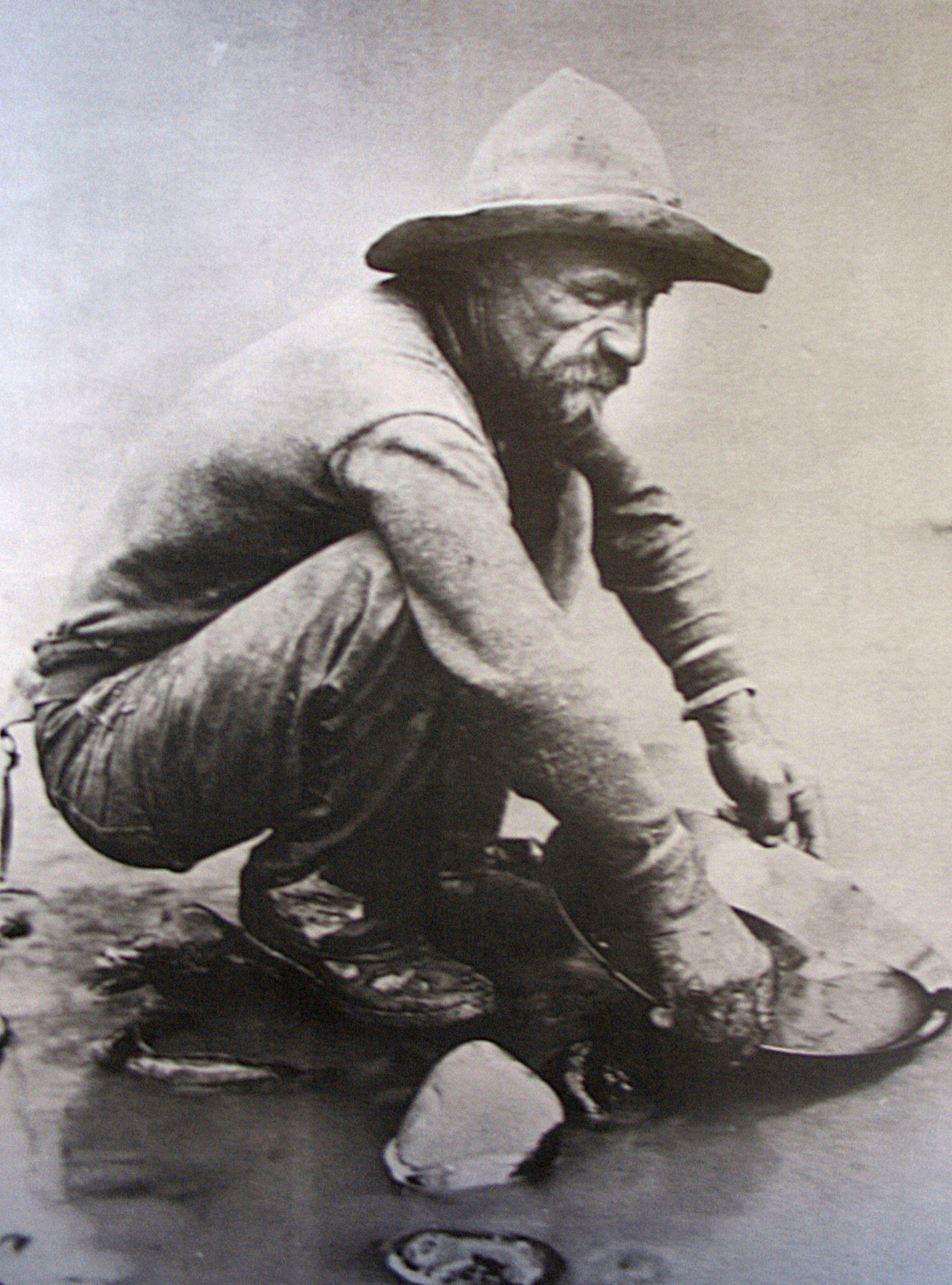
People set up mining camps in promising areas, and named them spirited names like 
Hell's Delight and Hangtown. Some people found golden fortune in the California 
riverbeds. Lucky forty-niners panned flakes and nuggets worth a fortune. 
However, most people did not become wealthy in the Gold Rush. When gold was found, 
the cache was usually cleared quickly by just a few. James Marshall had little success as 
a miner, and he died impoverished. John Sutter, who had once owned 39,000 acres, left 
California in heavy debt after miners trampled his land. 

Some people profited not from mining, but from charging miners for supplies and 
services. With some wealthy miners around, businesspeople could earn $2 for a pound of 
sugar, or $25 for a home-cooked meal! And when the gold ran out, many miners 
remained in California to form businesses too, or to farm the new state’s fertile valleys. 
By 1856, San Francisco boasted a cosmopolitan population of over 50,000 people. 
California had become the most exciting state in the nation. 

France and the American Revolution


In March of 2003, after France opposed a UN invasion of Iraq, two US Republicans 
removed all references to French fries from menus affiliated with the US House of 
Representatives. In the House cafeteria, potatoes became “freedom fries”. In a time of 
such Francophobia, some Americans might be surprised by the history of positive 
French-American relations. In fact, it’s likely that the American colonies would not have 
defeated the British without French support.

In the 1770s, French enthusiasm for the American Revolution was high. Intellectually, 
French Enlightenment intellectuals were agitating against their own feudal land systems 
and class privilege. Emotionally, French leaders had been eager to defeat arch-rival 
Britain since their Seven Years War. King Louis XVI had been privately supporting the 
colonists for some time. But now, formal support appeared more advantageous. France 
saw this as a strategic opportunity to secure North American landholdings and officially 
befriend a rising power. Ben Franklin also played a significant role in winning tangible 
French support; traveling with his wit and charm, Franklin visited Paris in 1776 to rally 
support for the colonists’ cause. France first assisted the rogue colonies in May of 1776 
by sending 14 ships loaded with gunpowder and other war supplies. 

In February of 1778, the colonists and the French signed a Treaty of Amity and 
Commerce. This was significant because France not only offered trade concessions, but 
also legally recognized the colonies as the United States. Most importantly, Ben Franklin 
also secured a Treaty of Alliance with King Louis XVI. This stipulated that if France 
entered the war against Britain: 1) neither France nor the US would surrender; 2) neither 
would agree to peace with Britain without the other’s consent; and 3) each guaranteed the 
other’s landholdings in America. Within a few months, British ships fired upon the 
French, and the two countries were at war. France sent about 12,000 soldiers and 30,000 
sailors to support the colonists. 

Many Frenchmen were truly committed to the cause of liberty. A former French Navy 
captain, Marquis de Lafayette, had such zeal that the French suggested he enlist in the US 
forces! He volunteered to become a major general for no pay. Lafayette became an 
effective military leader and a lifelong friend of General George Washington. He was 
eventually given honorary US citizenship. 

When France officially entered the war, Spanish interest was piqued. Motivated by the 
possibility of a land grab, Spain entered the war as a French ally against Britain. Holland 
followed suit. This combination of European powers was a much greater threat to Britain 
than the colonies could produce alone, and the crucial 1781 victory at Yorktown could 
not have been won without the French alliance.

Unfortunately for France, following the Battle at Yorktown, Ben Franklin engaged in 
secret negotiations with Britain. This was particularly insulting considering the French-
American treaties and France’s considerable wartime expenditures. Their hopes of 
becoming the main US trade partner were dashed when most American trade was 
contracted within the British Empire. Also, expectations of regaining French North 
American territories were mostly unmet.

Still, defeating the British brought France a definite taste of revenge. It also restored a 
sense of French confidence and esteem alongside other European powers. Furthermore, 
in spirit France was now ready for a revolution of its own. 

John O’Sullivan and America’s Manifest Destiny

When leaders wish to conquer foreign lands, they invariably put forth a list of 
justifications. In America in the 1840s, politicians and others invoked the phrase 
“manifest destiny” to optimistically explain continual territorial expansion by the United 
States. In modern terms, manifest destiny might be described as something that is 
“obvious and certain”. In short, leaders in the 1840s were arguing that American 
expansionism was quite natural and good, determined by fate. 

The term seems to have been coined mid-decade by journalist John O’Sullivan. In an 
essay entitled “Annexation”, O’Sullivan urged the US to annex Texas from Mexico. Not 
only was this justified because of Texans’ own wishes, O’Sullivan contended, but also 
because it was America's “manifest destiny to overspread the continent”. 
In a second and more widely-read column in New York Morning News, O’Sullivan 
reiterated his phrase when advocating for the US claim to “the whole of Oregon”. This 
time, he added the notion of a pro-expansion God:

And that claim is by the right of our manifest destiny to 
overspread and to possess the whole of the continent which 
Providence has given us for the development of the great 
experiment of liberty and federated self-government 
entrusted to us.

By invoking “Providence”, the journalist was suggesting that the highest moral authority 
actually supported the US annexation of the Oregon Country; since the British were not 
spreading democracy, their claims had lower moral status in the eyes of God. 
Ironically, O’Sullivan did not condone the violence that his phrase eventually supported. 
He had expected territorial expansion to be truly “natural”, coming about through 
settlements and voluntary annexation by residents. After all, residents of Texas actively 
sought to become the Union’s twenty-eighth state, and thousands of Americans had 
already migrated to the Oregon Country via the Oregon Trail. What could be more 
obvious and certain?

The actual process of expansionism entailed violence and suppression that a kindly god 
would not condone. The idea of “Indian Removal” garnered a following. Native 
Americans were removed from lands by force, and at the same time, some lands were 
desired solely for African American slave labor. This was clear to Henry David Thoreau, 
who asked:

How does it become a man to behave toward this American 
government today? I answer that he cannot without 
disgrace be associated with it. I cannot for an instant 
recognize that political organization as my government 
which is the slave's government also.

Ironically, O’Sullivan’s term was not popularized until seized upon by Whig opponents. 
Whigs in particular contested what “Providence” would desire; the “mission” of the 
United States, they maintained, was simply to behave as a virtuous (non-conquering) 
example for the rest of the world. 

In 1846, a Whig representative named Robert Winthrop ridiculed O’Sullivan’s concept 
when speaking before Congress. Observing the notion’s self-interest and chauvinism, he 
commented:

I suppose the right of a manifest destiny to spread will not 
be admitted to exist in any nation except the universal 
Yankee nation.

Despite this public criticism, the Polk Administration and other expansionists quickly 
embraced the phrase. The era of US history encompassing the War of 1812 through the 
Civil War is often called the Age of Manifest Destiny. During this time period the United 
States were expanded to the Pacific Ocean, and borders began to look much as they do 
today. 

The Midnight Ride of Paul Revere


"Listen children and you shall hear/The midnight ride of Paul Revere." So begins a 
famous poem penned by Henry Wadsworth Longfellow. The poet's rendition of events, 
while not historically accurate, is a great contribution to American folklore. Paul 
Revere's life was colorful, however, and facts alone make for interesting history. 

Paul Revere was a man of many trades. This father of sixteen worked a part-time dentist 
and once owned a hardware and home goods store. His most constant work though was 
with metal, and his work was highly praised. Revere cast cannons and bells, made silver 
teacup collections, and engraved the first Massachusetts state currency. He also produced 
the copper sheeting that covers the Massachusetts State House dome. 

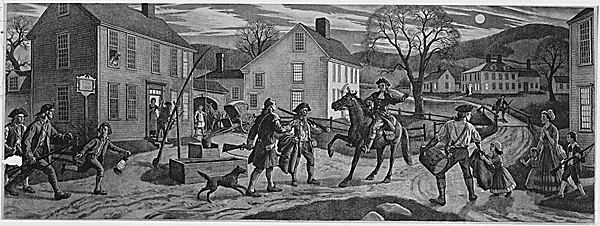
To many, however, Revere is best known for one night spent as a Pony Express rider. He 
was a midnight messenger right before decisive Revolutionary War battles in Concord 
and Lexington. On the night of April 18, 1775, Paul Revere and militia member William 
Dawes were dispatched from Boston. Dr. Joseph Warren, the chief executive of the 
revolutionary Massachusetts government, ordered the men to warn John Hancock and 
Samuel Adams of the British army's advancement across the Charles River. Warren 
feared that the British would arrest Hancock and Adams and capture their cache of 
weapons. 

Revere and Dawes were sent out in different directions; if either were caught, the 
message of an impending British invasion might still reach patriot leaders. They also had 
a back-up plan in case both men were caught. Revere instructed Robert Newman, who 
worked at the Old North Church, to communicate with lanterns. One lantern placed in the 
steeple would alert colonists to a land-route invasion; two would signal that the British 
were advancing "by sea" across the Charles River. As Revere set out on his midnight 
ride, Newman and Captain John Pulling briefly shone two lanterns from the Old North 
Church.

Contrary to Longfellow's poem, the riders did not shout, "The British are coming!" as 
they rode to Lexington; doing so could have easily brought their capture. Furthermore, 
the colonists themselves were British! However, Revere did pass the news to colonists 
along his route. Eyewitnesses reported the actual quote to be, "The regulars are coming 
out!"

Both Paul Revere and William Dawes arrived in Lexington without being captured. They 
met John Hancock and Samuel Adams at the Hancock-Clarke residence, which was 
Hancock's boyhood home. Hancock and Adams proceeded to update their battle plans. 
Meanwhile, Revere and Dawes decided to head to Concord where the weapons were 
being stored. A doctor named Samuel Prescott came along for the ride. 

The three men were detained en route to Concord. Prescott and Dawes escaped, and 
Dawes carried on to Concord. Paul Revere, however, was detained for several hours. 
King George's troops then escorted him toward Lexington at gunpoint - but before they 
arrived in the city, sounds of gunshots led his captors away. Revere was abandoned 
without a horse. He walked back to Lexington and arrived in time to see the Battle on 
Lexington Green. 

Revere's warning allowed the revolutionary militia to defeat the British troops in 
Concord. His role in the important midnight ride was not well-known until Longfellow 
published "The Midnight Ride of Paul Revere" in 1861, more than forty years after 
Revere's death. Today parts of Revere's famous route are marked with signs reading 
"Revere's Ride".


Copyright @ 2013 daily for info .

Designed by Templateify & Sponsored By Twigplay